




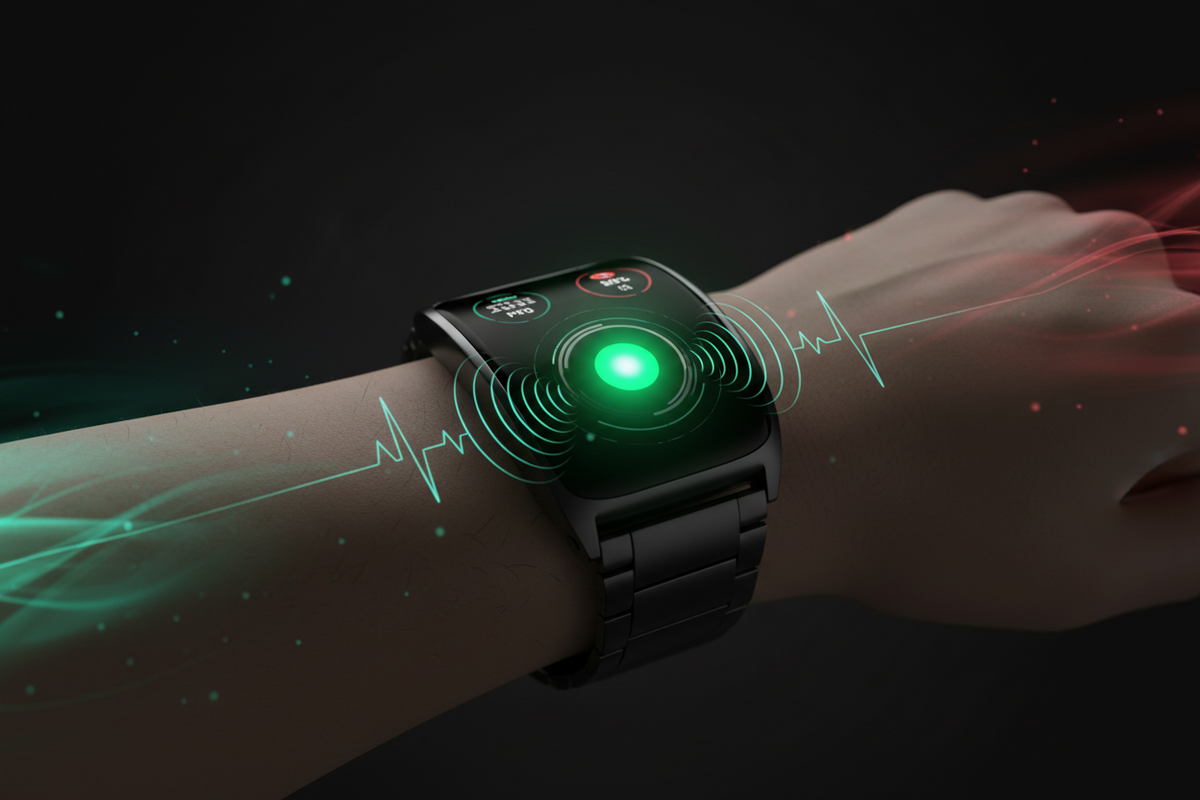
Ever glanced at your smartwatch and wondered—how does a tiny gadget on your wrist know when your heart is racing? Is there a mini doctor inside?
Nope. It’s just light. And it’s way simpler (and cooler) than you think.
The Short Version: It’s All About Green Light
Your watch uses a technology called PPG (photoplethysmography—don’t worry, you don’t need to pronounce it). Here’s what happens:
-
A green LED on the back of your watch shines light into your skin.
-
Your blood is red—and red blood absorbs green light better than the surrounding tissue does.
-
Every time your heart beats, more blood rushes through your vessels, so more green light gets absorbed. Between beats, less blood flows, so more light reflects back.
-
A tiny sensor catches those tiny flickers of reflected light, and your watch counts the flickers. That’s your heart rate.
Basically, your watch is counting how much green light “disappears” into your blood with every pulse. It’s like a light-based heartbeat counter.
So Why Does Red Light Show Up Sometimes?
You’ve probably noticed a red glow on your watch every now and then. That’s not for heart rate—that’s for blood oxygen (SpO₂).
Here’s the difference:
-
Green light = great for detecting pulse because blood absorbs it so well.
-
Red + infrared light = great for detecting oxygen levels, because oxygenated and deoxygenated blood absorb red light very differently.
So next time you see that red flash, your watch isn’t broken—it’s just checking your oxygen saturation.
Why Your Watch Sometimes Gets It Wrong
PPG is clever, but it’s not perfect. Here’s what can throw it off:
-
Movement – Running or waving your arms creates “motion artifacts” that can mask the real heartbeat signal. Your watch’s algorithms try to filter this out, but it’s not always 100%.
-
Skin tone – Darker skin has more melanin, which absorbs more green light and can reduce signal quality. Some studies have found error rates above 10% during faster movement for darker skin tones.
-
Tattoos – Dark ink can block light from reaching the blood vessels altogether.
-
Loose fit – If your watch isn’t snug against your skin, light leaks out and the signal gets noisy.
-
Cold weather – Cold makes your blood vessels constrict, which weakens the signal.
The Bottom Line
Your smartwatch isn’t reading your mind—it’s reading light. A green beam, a tiny sensor, and some smart math turn flickering reflections into your pulse. It’s not hospital-grade, but for everyday tracking? It’s pretty amazing.
And now, when someone asks how your watch knows your heart rate, you can tell them: It’s just counting the light your blood drinks up.
Pretty cool, right? 😉

Lämna en kommentar
Denna webbplats är skyddad av hCaptcha och hCaptchas integritetspolicy . Användarvillkor gäller.